
In the coffee shop in the morning, the sun shines through the french window on the wooden desktop. In the dense heat of a cup of latte, a transparent screen suspended in the air is slowly unfolding today’s morning news – no bulky black frame, no dazzling backlight, words and images are like being lifted by the morning mist, and naturally blend with the light and shadow of the real world. This is not a scene from a science fiction movie, but a daily poem being written on an OLED transparent screen.
1、 From ‘existence’ to ‘disappearance’: a self revolution of display technology
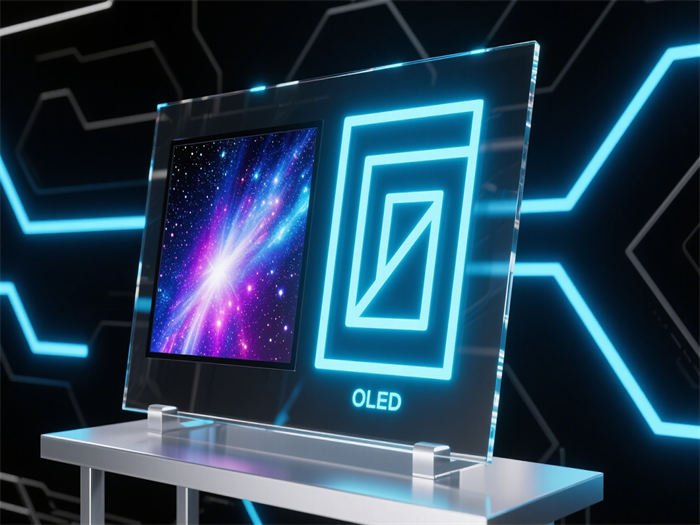
The essence of traditional display devices is a “container of light”: LCD screens require backlight panels to illuminate pixels, while LED screens rely on dense light beads to emit light. They are like lightboxes lit up in the dark, always declaring the boundaries of technology with a sense of presence. The breakthrough of OLED transparent screen lies in its complete subversion of this logic – through the precise combination of self luminous organic materials and transparent electrodes, each pixel can independently control the light emission and transparency state. When the screen is turned off, it is almost no different from glass; When the content emerges, it is like air that has been enchanted, projecting an illusion of interweaving reality and virtuality in the real scene.
This kind of “hidden” intelligence has shifted display technology from “competing for attention” to “service scenarios”. In the showcase of a jewelry store, a transparent screen can display both the 4C parameters and 3D model of a diamond, while the customer’s line of sight can still penetrate the screen and directly observe the actual object; On the glass of the subway carriage, real-time arrival information overlaps with the speeding scenery outside the window, which not only does not obstruct the view, but also enhances spatial orientation. Technology is no longer a tool that needs to be ‘adapted’, but has become a part of the environment itself.
WeChat screenshot _20250805181130_ Copy 1. png
2、 The “Transparent” Philosophy of Transparent Screen: The Third Space of Virtual Reality Coexistence
When the physical boundaries of the screen disappear, the way people interact with information also evolves. In the cultural relics display cabinet of the museum, a tilted transparent screen can simultaneously present the historical background, three-dimensional structure, and restoration process of bronze ware. The audience does not need to turn their heads back and forth between the actual object and the explanatory board. Wherever their gaze goes, history and technology naturally overlap; In the smart home scene, the transparent refrigerator door in the kitchen can display the shelf life of ingredients and recipe recommendations without obstructing the observation of internal food – this “penetrating interaction” makes information acquisition as natural as breathing.
Even more intriguing is that transparent screens are creating a ‘negative space aesthetic’. In the atrium of the commercial complex, a set of suspended transparent screens form a dynamic art installation. During the day, they serve as a medium for advertising, while at night they transform into glowing nebulae, forming a dialogue with the building’s own lighting system; On the car windshield, AR navigation information is overlaid with the real road, and the driver’s line of sight does not need to switch between the dashboard and the road surface, improving both safety and immersion. Technology is no longer a cover up of reality, but an interactive ‘light and shadow layer’ added to the real world.
3、 When technology returns to humanity: the “restraint” and “temperature” of transparent screens
Although the potential of OLED transparent screens is almost unlimited, truly excellent applications often begin with reverence for the scene. A high-end hotel once attempted to embed a transparent screen in the bathroom mirror of guest rooms for playing music or displaying weather, but ultimately gave up due to guests complaining about “always worrying about the screen getting wet while taking a shower”; On the contrary, a children’s hospital installed transparent screens on the glass walls of the infusion room, playing cartoon animations and health knowledge, which not only distracted the attention of young patients, but also maintained the transparency of the space – this “temperature sensitive technology” is the core value of transparent screens.
The design philosophy of transparent screens is essentially an extension of modernism that says’ less is more ‘. It refuses to attract attention with dazzling special effects, but instead uses “invisibility” to make the content the protagonist; It does not pursue “full scene coverage”, but focuses on those segmented scenes that require “virtual real integration”. When a screen can display information, allow sunlight to penetrate, extend vision, and breathe space, it is no longer a cold electronic device, but a “transparent bridge” connecting the digital and physical worlds.
Conclusion: Seeing the Future in Transparency
Standing at the crossroads of technology and humanities, the true charm of OLED transparent screens lies not in how many technical parameters they have broken through, but in redefining the essence of “display” – not by replacing reality with virtual, but by enhancing reality with light and shadow; It’s not about making humans adapt to technology, but about making technology serve human perception and experience. When a screen can be as light as morning mist and as natural as air, perhaps we can finally say: technology has finally learned how to gracefully exit.